NEET UG Re-Exam 2026 Conducted Across 5,440 Centres; NTA Thanks ‘Team Bharat’ For Delivering One Of India's Largest Examinations
· Free Press Journal
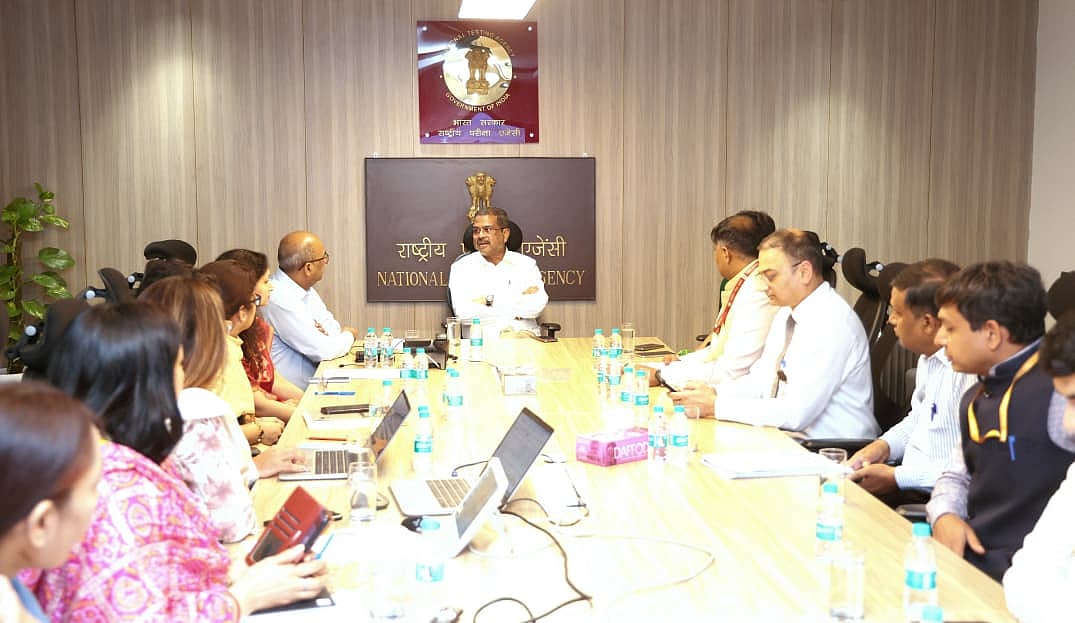
After the successful conduct of the NEET UG 2026 re-examination on June 21, the National Testing Agency (NTA) has expressed gratitude to what it described as "Team Bharat", the vast network of officials, institutions, security personnel, experts and government agencies that came together to conduct one of the largest entrance examinations in the world.
Team NTA, Team Bharat: How India Came Together for NEET (UG) 2026
On 21 June 2026, more than 20 lakh candidates sat for the NEET (UG) 2026 re-examination across 5,440 centres in India and 14 centres abroad. The paper was administered in 13 languages, including Hindi and English.…Visit afsport.lat for more information.
— National Testing Agency (@NTA_Exams) June 21, 2026
More than 20 lakh candidates appeared for the examination, which was held at 5,440 centres across India and 14 centres abroad. The test was conducted in 13 languages, including English and Hindi, under an unprecedented security and monitoring framework.
In a message released after the examination, the NTA said the successful conduct of NEET UG 2026 was not the effort of a single organisation but the result of coordination across every level of government and administration.
More than an exam, A nationwide operation
For candidates entering examination halls on Sunday afternoon, the focus was naturally on Physics, Chemistry and Biology. Behind the scenes, however, a massive logistical operation had been underway for weeks.
The examination involved coordination between central ministries, state governments, district administrations, law enforcement agencies, educational institutions and thousands of examination staff members spread across the country.
According to the NTA, nearly seven lakh personnel, including police teams, observers, invigilators and examination staff, were mobilised to ensure the smooth conduct of the examination.
Officials noted that the entire exercise was completed within a record period of 37 days.
Special arrangements for students facing medical challenges
Among the lakhs of candidates who appeared for NEET UG 2026 were more than 10,000 Persons with Disabilities (PwD), for whom dedicated arrangements were made.
The NTA also facilitated special support for around 81 candidates dealing with serious medical conditions.
These included students recovering from major health complications, a candidate injured in a road accident and another undergoing chemotherapy treatment. Despite their circumstances, the candidates were able to appear for the examination after customised arrangements were made at their respective centres.
Officials said ensuring that such candidates received a fair opportunity required extensive coordination between examination authorities, hospitals, local administrations and centre officials.
Security network spread across the country
The examination was conducted under one of the most comprehensive security systems ever deployed for a national entrance test.
Aadhaar-based biometric verification and face authentication were implemented at centres to confirm candidate identities. CCTV surveillance, signal jammers and two-layer frisking procedures were also put in place.
To monitor the examination in real time, command-and-control centres were established at multiple levels.
These included monitoring centres at the NTA headquarters, the Ministry of Education, 34 Centrally Funded Institutions under the Department of Higher Education, State Governments and District Collectorates across the country.
The surveillance network was designed to ensure transparency and quickly address any irregularities.
Government agencies join hands
The NTA acknowledged the support of several ministries and departments that contributed to the conduct of the examination.
These included the Ministry of Education, Ministry of Home Affairs, Ministry of Defence, Ministry of Health and Family Welfare, Ministry of Railways, Ministry of External Affairs, Department of Posts, Department of Financial Services, National Informatics Centre (NIC), Ministry of Electronics and Information Technology (MeitY), the Indian Air Force and the Central Armed Police Forces (CAPF).
Banking partners including State Bank of India, Canara Bank, Punjab National Bank and UCO Bank also assisted in various operational aspects of the examination.
The agency said the successful conduct of NEET UG 2026 reflected an unprecedented level of coordination between the Centre, states and local administrations.
States extend support to students and parents
Several state governments also introduced additional facilities to make examination day easier for candidates and their families.
Authorities arranged drinking water, shaded waiting areas and food facilities at many centres. Ambulances and medical teams remained on standby, while some states provided free transportation for students travelling to examination venues.
Officials described the effort as a national protocol implemented through local care, with district administrations adapting arrangements according to the needs of candidates on the ground.
Experts behind the question papers
Apart from security and logistics, the NTA also acknowledged the contribution of academic experts from institutions across the country.
According to the agency, subject specialists voluntarily dedicated their time and expertise to prepare multiple sets of question papers, helping ensure the integrity and fairness of the examination process.
The agency said their contribution often remains invisible to the public but plays a crucial role in maintaining the credibility of national-level examinations.
‘A Fair Chance, A Fresh Start’
With the examination now completed, the NTA used the occasion to thank both candidates and the countless individuals who worked behind the scenes.
More than 20 lakh aspirants sat for a single examination on June 21, but the event represented something much larger, a coordinated effort involving ministries, bureaucrats, police personnel, district officials, educators and support staff across the country.
"To every candidate who wrote on June 21 - well done. And to everyone who made it possible: thank you. Team NTA. Team Bharat. One exam, delivered together," the agency said.
As the focus now shifts to evaluation and results, the NTA's message highlighted the scale of what unfolded on a single day, a nationwide effort aimed at ensuring that every student received what the agency called "a fair chance and a fresh start."