How Young Indians Are Redefining Spirituality Beyond Religion
· Free Press Journal
For 25-year-old Aditi, birthdays no longer mean elaborate dinners or being within the confines of a club. Over the last few years, she has consciously chosen to spend them differently - first at the Vaishno Devi Temple, and later amidst the towering silence of Kedarnath Temple. What began as a spontaneous decision slowly turned into a personal ritual. “I realised I felt calmer and more emotionally present in these spaces,” she says. “It wasn’t necessarily about religion for me, but about feeling grounded and disconnected from the noise of everyday life.” Like many young Indians today, Aditi finds herself drawn towards spirituality not through rigid traditions, but through experiences that offer stillness, reflection, and a sense of emotional comfort in an increasingly overwhelming world.
Visit freshyourfeel.org for more information.
Across urban India, a growing number of young people are turning toward spirituality. Bhajan clubbing nights, tarot readings, manifestation journals, mindfulness podcasts, energy healing circles, sound baths, meditation retreats and more are increasingly becoming part of Gen Z and millennial lifestyles. While organised religion may feel distant or rigid to some, spirituality is finding renewed relevance.
Algorithm Of Healing
Imagine you’re going through something - a personal crisis, workplace stress, or relationship troubles. Almost instantly, your algorithm seems to pick up on it. Suddenly, tarot readers begin appearing across your feed, asking you to choose a card and offering eerily specific conclusions, almost as though they know exactly what’s unfolding in your life. And more often than not, they tell you precisely what you want to hear - something comforting, hopeful, optimistic. It feels as if the algorithm has read your mind - which, in many ways, it already has. The only difference now is that it arrives wrapped in the language of spirituality and reasoning.
But are we the only ones to blame? Consider the moment when one of the defining designers of our time, Jonathan Anderson, shared an image of a tarot reading by Trevor Ballin. This post quickly went mildly viral online.
View this post on Instagram
On Instagram, these tarot readers attract millions of views by offering relationship advice, emotional validation and a sense of direction during uncertain times. Manifestation culture - once considered niche - has entered mainstream conversations among young Indians who speak casually about vision boards, affirmations and ‘aligning energies’.
“Something has shifted. I've watched it happen slowly, then all at once. Seventeen years of reading birth charts has taught me that people don't stop seeking the sacred; they simply stop accepting it in its old packaging. Today's young Indians aren't abandoning spirituality. They're rebuilding it, on their own terms,” reasons astrologer Silky Kukreja.
Another young professional, Aparna, found herself turning toward a very different corner of modern spirituality after a difficult breakup. The 26-year-old marketing executive recalls stumbling upon online ‘love spell’ websites and manifestation forums. “I know it sounds weird,” she laughs, “but I think I once came across this free website that said I could put a spell into the universe to get back with him. I ended up trying it quite a few times.” When asked whether it worked, she pauses before smiling. “Well, technically yes, he did message. But it didn’t last.” She admits the ritual gave her temporary emotional comfort during a vulnerable period. “I think it gave me hope more than anything else. At that time, I just wanted to feel like I had some control over what was happening.”
But beyond tarot readings and manifestation rituals, an entire ecosystem of modern spiritual wellness has quietly emerged around young urban consumers. Across cities, you can find healing workshops, sound bath sessions, cacao ceremonies, breathwork retreats and mindfulness gatherings. Reiki sessions, crystal healing, guided meditations, and energy-cleansing circles are marketed with the same aspirational appeal as fitness classes or weekend brunch plans. Spirituality, in many ways, has become part of a global dopamine menu - one where a stressed young consumer can move seamlessly from ordering crystals online to attending a sound healing retreat in Rishikesh.
I still remember wandering through the colourful streets of Haji Lane in Singapore when a delicate crystal earring displayed outside a boutique caught my attention. As I stood browsing through trays of gemstones and jewellery, the shopkeeper casually offered to include a crystal reading about my future along with the purchase, almost like a complimentary add-on packaged beside the accessory itself.
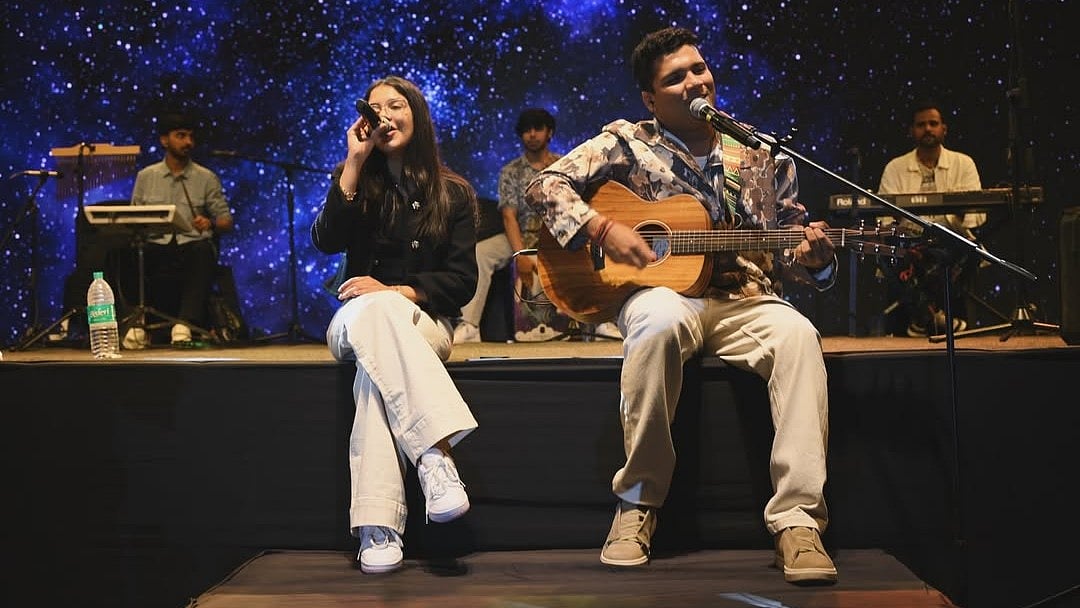
Among the many expressions of this spiritual shift, bhajan clubbing has emerged as one of the most telling. Blending devotional music with the energy of a live social gathering, these events are increasingly attracting younger audiences looking for connection, emotional release, and community-driven experiences outside the framework of conventional nightlife.
Prachi and Raghav Agarwal, former finance professionals, built Backstage Siblings. The trend gained significant visibility in 2021 after a video showing a packed room singing “Shri Krishna Govind Hare Murari” circulated widely online. The clip, created by the sibling duo, introduced many young audiences to a format that blended devotional music with the energy of a live social gathering. Since then, Prachi and Raghav Agarwal have built a loyal following through intimate live sessions. Some events have drawn massive crowds, signalling a growing appetite for spiritual experiences that feel communal, emotionally immersive, and socially accessible.
“What’s interesting is that young people are not necessarily rejecting tradition,” says a Delhi-based sociologist, Ankur, who has attended one of these bhajan clubbing sessions. “They are reinterpreting it. A devotional chant in an electronic music setting may look unconventional, but it reflects an attempt to make older cultural practices emotionally and socially relevant within contemporary life.”
What may once have been considered niche or alternative is now being repackaged through the language of wellness, emotional healing, and self-optimisation. “This trend is far from temporary. Spirituality will increasingly shape consumer behaviour as well. People will begin choosing beauty, fashion, fragrances, travel, food, relationships, and even social circles based on energy alignment, aura perception, and emotional resonance. Spirituality is moving from the realm of private belief into everyday lifestyle decision-making - much like it once did in historical societies,” says Sidhharrth S Kumaar, chief astrologer and founder of NumroVani.
Emotional Need For Grounding
Mental health professionals say the rise of modern spirituality among young people is closely tied to the emotional conditions of life. Unlike institutional religion, which may come with fixed structures or expectations, modern spirituality often allows individuals to build belief systems on their own terms. “Organised religion asks for obedience. In my experience, this generation is not moving away from faith; they are simply redefining it in their own way. And frankly? I think the universe is listening,” says Kukreja. “You may see them follow Reiki healers on Instagram, listen to manifestation podcasts on the commute, and text each other affirmations. But, there’s clarity. Raised between temples and TED Talks, they've learned to hold both, and I honestly find that beautiful.”
Dismissing the movement entirely as superficial would overlook the genuine emotional needs driving it. For many young people, spirituality today is less about doctrine and more about finding tools to cope with an increasingly fragmented world. “Many young Indians feel emotionally unsupported despite being constantly connected. Families certainly care, but most often do not speak the same emotional language around anxiety, burnout, identity, dating, and loneliness, leading to perceived care as zero. Friends can also feel more judgmental than safe. Modern spiritual spaces are filling that gap. Bhajan gatherings, tarot, healing circles, manifestation communities, and spiritual podcasts offer belonging, emotional vocabulary, and people with similar frequencies. For many, this is also self-expression. Spirituality is becoming part of personal identity, much like music, fashion, or wellness choices,” reasons Sidhharrth.
That search for authentic connection may partly explain why spirituality is resonating so strongly with Gen Z. But in an ocean of options, how does one find what truly resonates with them? More often than not, it comes down to the emotional experience attached to the practice itself.
Done With Hustling? Why Young Indians Are Choosing The ‘Soft Life’Sidhharrth explains that for the younger generation today, spirituality is less about rigid structures and more about being honest, transparent, and unapologetic about what they feel. “There are two major cohorts of people. The first are those who experiment with different practices depending on their cognitive conditioning and the kind of content they consume, and then eventually zero in on one thing,” he says. For instance, someone seeking calm may connect deeply with meditation, someone needing reflection may resonate with tarot, while another looking for emotional release may gravitate toward chanting, prayer, or healing work. “Then there’s another cohort,” he adds, “who consult an occult expert - whether an astrologer, numerologist, tarot reader or psychic - and seek guidance on what spiritual path or practice may suit them best.”
For 27-year-old Rohan, who attends community meditation gatherings in Pune, spirituality became a response to emotional exhaustion. “Meditation groups gave me a sense of grounding. People were there to connect without trying to impress each other. I wouldn’t call myself religious, but I became more aware of needing spaces that felt peaceful.”
This is a generation - and perhaps a time - where discussions around healing, boundaries, energy and mindfulness have become deeply embedded within everyday conversations, both online and offline. For some, spirituality becomes a coping mechanism; for others, a form of self-discovery. And for many, it is simply a way to feel a little less alone. Perhaps that is why modern spirituality resonates so strongly today. Well, don’t we all seek a glimmer of hope sometimes, somehow?