Samsung Galaxy S26 Ultra Early Adopters Report Issues With Privacy Display
· Free Press Journal
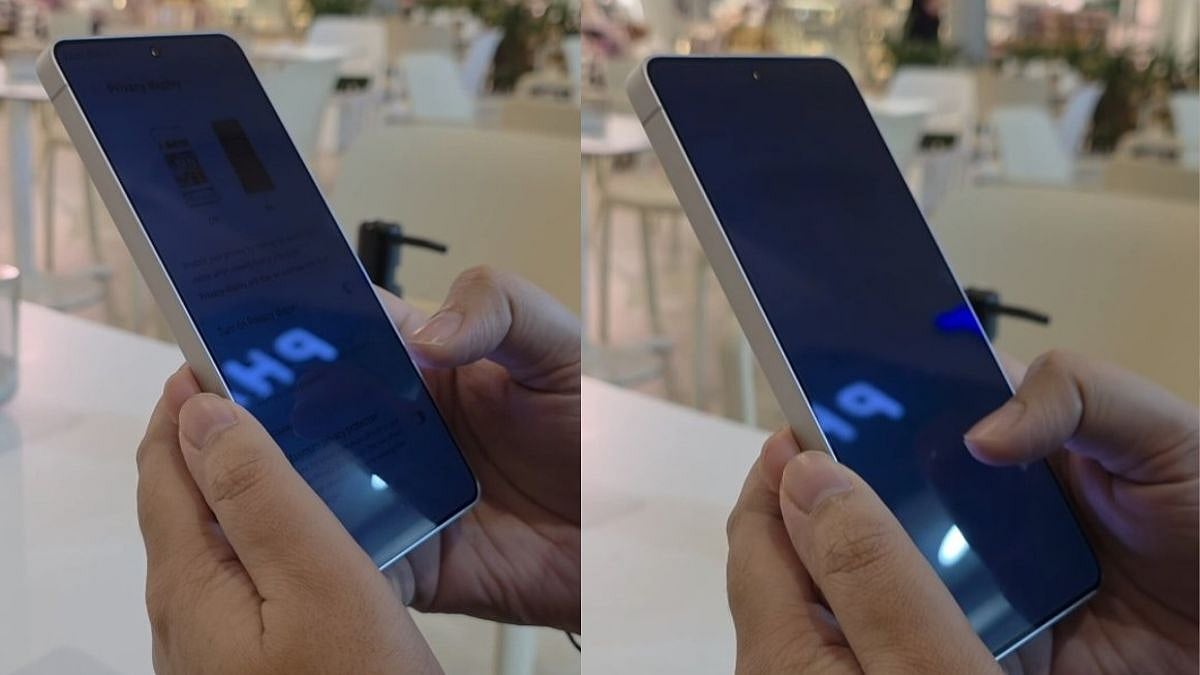
Samsung billed the Galaxy S26 Ultra's built-in Privacy Display as the flagship's killer new feature - the world's first smartphone screen with hardware-level privacy built directly into the OLED panel. But since the phone launched, a growing chorus of complaints has emerged. Samsung has been forced to acknowledge display tradeoffs, and some buyers have already sent their units back.
Visit asg-reflektory.pl for more information.
The core problem: It affects the screen even when turned off
The most alarming complaints center not on what the Privacy Display does when active, but on what it does to the screen at all times. Close-up images of the Galaxy S26 Ultra show that the display appears less refined than the one on the Galaxy S25 Ultra, with noticeably rougher text edges and color bleeding visible even with Privacy Display disabled.
Because a portion of the pixels are physically directional, their brightness contribution weakens at slight angles even when Privacy Mode is disabled, potentially leading to subtle variations in clarity or brightness during normal use. Well-known tech leaker Ice Universe described the issue using an analogy: imagine drawing a line with two pens - one with a thick tip that spreads ink widely, and one fine-tip pen that only marks straight down. Viewed from the side, the fine-tip ink "disappears," making edges look inconsistent.
Galaxy S26 Ultra Privacy Display Issues
— GadgetBracket (@GadgetBracket) March 8, 2026
Key negatives:
Brightness drops ~50%
Lower pixel density
Worse contrast & colors (max mode)
Privacy still limited at angles
Works mainly in system apps#Samsung #GalaxyS26Ultra #DisplayIssues pic.twitter.com/AGLa0KBFpz
Galaxy S26 Ultra is a skip, due to display issues even when ”Display Privacy” feature is OFF.
— Samir Khazaka (@SamirKhazaka) March 8, 2026
Seems to be caused by privacy display hardware design choices, unsure if it can be fully mitigated with software.
Hopefully this privacy display tech can be fixed for the S27 Ultra.
Lab testing confirmed the brightness concerns. Tom's Guide found that even with Privacy Display fully disabled, the S26 Ultra's screen is not as bright as the S25 Ultra - and the difference is especially noticeable when the phone is viewed at wider angles.
Eye strain and user complaints
According to initial reports, the Samsung Galaxy S26 Ultra's display is straining users' eyes after only short periods of use - and this is without Privacy Mode turned on. Some users sensitive to PWM flicker have also reported headaches after extended use.
Prominent leaker Ice Universe stated he was investigating and "did not believe this is a minor matter," while recommending that prospective buyers compare the S25 Ultra and S26 Ultra side by side in a store before purchasing.
Some buyers are returning their phones
The concerns have translated into real returns. One Reddit user, explained why they returned their S26 Ultra: while the phone excelled in many areas - better cooling for gaming, improved HDR video quality - the Privacy Display caused problems when trying to share the screen with someone nearby, with even a small tilt making the display look strange. The user described the visual effect as feeling like their eyes were "switching modes," similar to viewing images on a 3D Nintendo 3DS.
At least one potential buyer cancelled their pre-order entirely after the reports emerged, opting for a Galaxy S25 Ultra instead.
How does the privacy display feature work
The Samsung Galaxy S26 Ultra's display is a fascinating piece of hardware, combining two different types of pixels: standard pixels that emit light in a wide cone, and new "narrow" pixels that focus light so it only propagates forward. When Privacy Display is enabled, the narrow pixels restrict what side-angle viewers can see. Independent testing from UL Solutions showed that with the privacy feature turned on, brightness at a 45-degree angle drops to about 3.5%, compared to roughly 40 percent on conventional panels.
In theory, this is genuinely innovative - a toggle-able privacy screen without the need for a physical accessory. In practice, the implementation has introduced a set of problems that users and reviewers are finding hard to ignore.
Samsung officially responds to the issue
Samsung has now officially acknowledged the issue. In a statement to Stuff.tv, a Samsung Mobile spokesperson confirmed, "Privacy Display is designed to protect user privacy by providing a vivid visual experience for using the phone in normal use. Some variation will be seen when the phone is held at certain angles and when set to maximum brightness. However, most users will not notice any impact when holding the phone as they normally would and with typical brightness settings."