I Play Rocky Is Undeniably Charming
· Jacobin
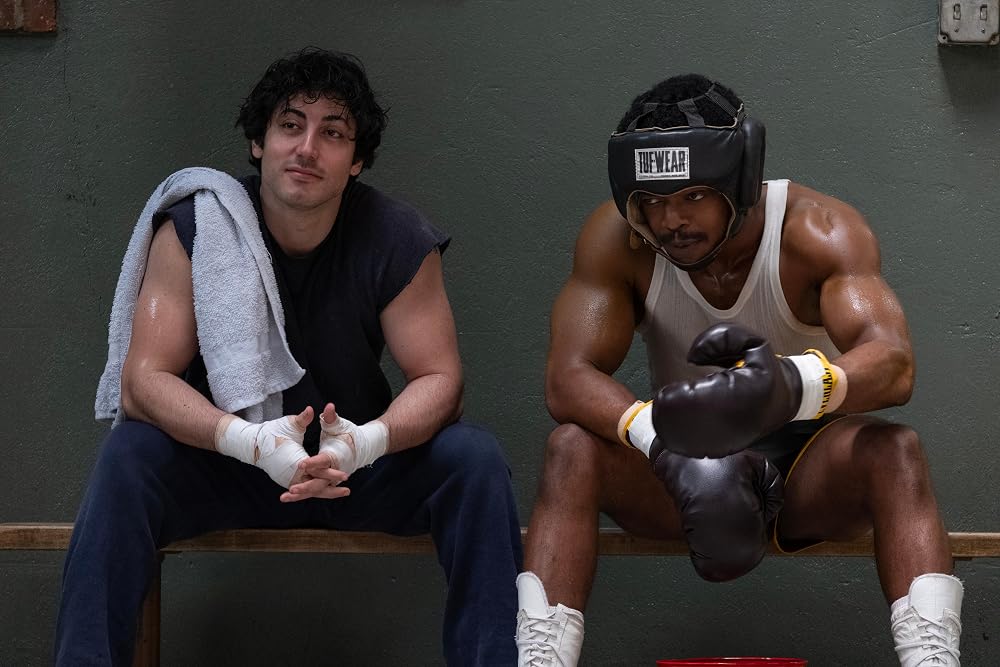
I Play Rocky goes for earnest meathead sentimentality in the most shameless way, which is presumably why it’s undeniably a crowd-pleaser. It makes Song Sung Blue (2025) — another heartwarming underdog story of working-class American dreamers making good against all odds — look like the height of sophistication.But whereas Song Sung Blue was about delightfully “Midwest nice” characters wearing sequined outfits in a Neil Diamond tribute band who find unlikely fame, I Play Rocky is the semi-fictionalized story of how Sylvester Stallone got Rocky made. The sleeper hit of 1976, Rocky was produced on a shoestring budget, spawned a zillion-dollar Hollywood franchise, and made Sylvester Stallone an overnight star. Stallone wrote the script and starred, though he was a relatively unknown actor at the time. According to I Play Rocky, it was his incredibly stubborn insistence on playing the title role that nearly torpedoed the project again and again — and that gives this movie its name.Screenwriter Peter Gamble and director Peter Farrelly (Green Book) go for the obvious crowd-pleasing approach, making Stallone’s story virtually identical to Rocky Balboa’s, with almost no daylight between them, except that Stallone reads a lot. Rocky’s a boxer whereas Stallone’s an actor trying to break through by writing himself a good film role, but both are essentially lonely, bighearted laboring lugs given no chance in life, working bottom-of-the-barrel jobs and barely getting by, who chance upon one big flukey opportunity to prove their worth. This involves “going the distance,” putting everything they have on the line when all they have is their mental endurance and — especially — their endlessly tested, repeatedly wounded, ultimately exhausted bodies.Such suffering becomes the keynote of Stallone’s star persona; he’s the sad-eyed hulk getting tortured and railroaded by everybody but enduring what nearly kills him and then coming back stronger in the end. Stallone’s other hit franchise, Rambo, would only intensify the cyclical martyrdom of a muscle-bound saint who slurs his words.The Myth vs. RealityI Play Rocky pushes Stallone’s hardships to the limit, several levels beyond what they were in real life. Luckily, newcomer Anthony Ippolito has a fairly light touch with his Stallone impersonation, making it possible to stay in your seat for two hours of melodramatized working-class striving and deep-voiced mumbling. Stallone was a struggling twentysomething actor and writer when he came up with the script for Rocky, sure, but in real life, he was not a total nobody in the entertainment industry. He was actually getting traction as an actor — you can see him in a small but notable part in a mainstream Neil Simon comedy, The Prisoner of Second Avenue (1975), which came out the year before Rocky. In it, Jack Lemmon’s character, getting steadily driven mad by the challenges of life in New York City, becomes convinced Stallone’s character is a mugger stalking him and, in an irrational rage, chases him relentlessly through Central Park. Finally, Stallone collapses and hands his wallet over to Lemmon, because he’s a perfectly innocent guy now convinced that Lemmon is a mugger.Stallone is quite effective in the part. He also had one of the leads in The Lords of Flatbush (1974), an independent ensemble film full of rising talent like Henry Winkler and Armand Assante — not the negligible background role I Play Rocky suggests.Plus, he wasn’t sitting on a pile of unsold scripts before he hit it big with Rocky — Stallone had already sold one, Hell’s Kitchen (later Paradise Alley), and he had agents who fought hard to keep him on as the lead. There was no conspiracy to make the low-budget production of Rocky so grueling and impossible that director John Avildsen (Jay Duplass) would be sure to fall behind, giving the studio an excuse to replace Stallone in the lead, as I Play Rocky depicts. Keep in mind that it was the 1970s, and studios had been giving young up-and-coming talent terrific early career opportunities since the late 1960s when it became clear that Hollywood business as usual wasn’t cutting it anymore.Stallone did run miles in beat-up sneakers during the first few days of shooting Rocky, winding up with shin splints and presumably some pretty bad blisters. But there’s no evidence he had a torn tendon and a grave doctor telling him he mustn’t walk at all for several weeks or else suffer some mysterious, unstated, forever crippling consequences.There are tidbits of cool info in Rocky, such as the experimental use of the Steadicam operated by inventor Garrett Brown. Though I Play Rocky makes it seem as if the only way to complete Rocky on its absurdly tight schedule was to shoot the entire movie using the Steadicam, which is definitely not what happened; not even close. But people making biopics never know when to stop.The movie is angled so hard toward a naively idolizing view of Stallone and his all-or-nothing gamble, you might find yourself laughing out loud at certain points. I know I did when, during the early scenes of the Rocky shoot, Stallone starts running all out, and two formerly jaded Philadelphia crew members, tough blue-collar guys, watch him with wide eyes. “Jesus, that guy is fast,” murmurs one reverently, as if he’d just witnessed the Second Coming.The best parts of the film are either the funny parts or the slightly edgy parts, which figures, given Peter Farrelly’s history as one of the Farrelly brothers responsible for crass and riotous comedies Dumb and Dumber (1994) and There’s Something About Mary (1998). Stephan James is energetically funny as Carl Weathers, the football player turned actor who struts into the audition to play Rocky’s prizefight opponent, a supreme Muhammad Ali–like boxer, as if Weathers himself were a master in the ring, which it turns out he definitely is not.The tendency of actors to lie in order to get cast becomes an amiable running gag in I Play Rocky, giving Kiki Seto as Talia Shire, who’s playing Rocky’s love Adrian Pennino, a nice comic moment when she’s supposed to do the skating scene and can’t skate. Tracy Letts is also amusing as the embittered, grousing Sandy Maddox, a composite of several United Artists executives — though colorfully awful Hollywood types make for pretty easy laughs. And Matt Dillon is quite good as Stallone’s malevolent father, Frank Sr, a man who became a hairdresser to support his family but never reconciled himself to his fate and takes his bitterness out on his son.The Understandable Nostalgia for 1970s CinemaA nostalgia for the gritty 1970s is inevitably part of the movie’s appeal, especially when little shards of the unvarnished reality of the era stab through, such as the 1975 boxing match between Muhammad Ali and Chuck Wepner that supposedly inspired the Rocky script. Stallone is shown watching the actual fight — which is riveting — on one of those small, chunky old TVs hanging over the bar in a local New York City dive. We get to see key moments such as when Wepner, a hulking white fighter shambling around the infinitely quicker and more formidable Ali, nevertheless manages to get in a surprise punch and knock Ali flat on his ass. Realizing he’s underestimated his opponent, Ali commences to batter Wepner relentlessly, but Wepner somehow stays on his feet into the fifteenth round before the fight is stopped and Ali wins on a TKO.Like a lot of movies in the recession-era 1970s, Rocky was all about working-class struggle and the blind hope that some miraculous chance would allow the protagonists to escape their bleak fates or at least redeem their thwarted lives in some sort of meaningful way. A solid number of these movies were centered on sports, whether they were comedies or dramas — see the darkly hilarious hockey movie, Slap Shot (1977) as the perfect example. These narratives often played out against an all-too-realistic backdrop of government and corporate corruption in the United States, the collapse of the industrial economy, the crumbling of infrastructure, the rising of unemployment, and the general impoverishment of the American population.I Play Rocky obviously preserves some of the lower-class misery these films emphasized, but all in the sweetening context of what we know is a success story so huge it’s like a fairy tale. The most dangerous edge of 1970s films, so many of which were remarkably grim and unsparing, has all been softened and planed away by a lot of hokum and an avoidance of the more harrowing aspects of Rocky. There’s no depiction, for example, of Rocky’s brutal beating in the ring at the hands of Apollo Creed as he loses the fight, or his raw screams for Adrian at the climactic moment of the film. This is notable because, in I Play Rocky, there’s a whole subplot featuring director John Avildsen’s old-pro wisdom about the one memorably emotional scene in a film that can make it a success even if the rest of the movie isn’t so hot, and his urgent advice to Stallone to dig deep and do the best acting of his life in such a scene. It turns out not to be the “Adrian!” scene you might be expecting.The Biopics Won’t EndI Play Rocky is a bit like another recent hit biopic, Michael, which also focuses, even more worshipfully, on the early life of a hugely successful star — in that case, Michael Jackson. As with the Sylvester Stallone story, the all-purpose villain of the piece that both scars and motivates Michael Jackson is his abusive father. And both films end at the point before the star’s life becomes darkly messy and very hard to sanctify.Consider what any sequels to I Play Rocky would potentially have to deal with. Ten years after Rocky made him a star, Stallone is divorced from his wife Sasha Czack, who’s played by AnnaSophia Robb in I Play Rocky and represents his stalwart true love and devoted wife and mother of his first child.In 1985, not long after the divorce from Sasha, Stallone swiftly married model and actor Brigitte Nielsen, who played a role in Rocky IV (1985), written and directed by Stallone. The couple’s short union and ugly divorce began an extended roiling period of Stallone’s personal life that made him a favorite of the tabloid press. His tangled involvements with various models — Janice Dickinson, Angie Everhart, and Jennifer Flavin, whom he married in 1997 — kept supermarket aisle readers entertained for years. Various unsavory accusations of physical and sexual abuse against Stallone by romantic partners that allegedly occurred from the mid-1980s through 2000, including allegations by his own half sister, have kept his lawyers busy through the years. (Stallone denied, and continues to deny, all of the allegations.)As for all the inspirational bonding between Stallone and the tough but ultimately mensch-like producers of Rocky, Irwin Winkler and Robert Chartoff (played by P. J. Byrne and Toby Kebbell in I Play Rocky), Stallone’s hatred of Winkler has long been on the record, though he claims to have loved Chartoff. At various points over the years of the franchise, Stallone has called out the elderly Winkler in the media as “remarkably untalented and parasitical,” and accused Winkler’s “moronic vulture children,” Charles and David, of “picking clean the bones” of the Rocky franchise.This feud is based on the original contract that gave the producers an equity stake in a potential franchise but deprived Stallone of one, though he continues to reap other forms of profit from Rocky movies and, of course, is very, very rich. Still, he could always be a bit richer, and it’s a fair enough point — Hollywood contracts are notoriously cutthroat. In I Play Rocky, Stallone doesn’t even read the contract before signing it, much less get a lawyer or agent to look it over.But in I Play Rocky, Winkler and Chartoff go from tough, dismissive Hollywood producers to schmaltzy, huggable slobs, and the film ends with everyone beaming over their shared success. That’s a recognizable emotional trajectory of filmmaking — lots of temporary sentimentalists in the film business giving bear hugs right before the shiv goes in — and it should be noted that both producers really did put up their houses as collateral in order to get studio funding for Rocky. But there’s no indication of the sharp dealing going on or Stallone’s vengeful fury to come.In short, I Play Rocky takes a slightly unusual approach to the biopic — focusing just on the story of Sylvester Stallone getting Rocky made and becoming a star — but otherwise it’s completely typical of the genre. That’s not a compliment, but it hardly matters; audiences love biopics regardless. It’s a shame the biopic isn’t formally classified as a subgenre of fantasy. That would clear up a lot about how these films get made.This article originally appeared in Jacobin, a democratic socialist magazine publishing long-form essays and analysis on politics, economics, and culture. Subscribe to the print edition for $20 a year.
Visit newsbetting.bond for more information.