The Iran War Might Soon Get Catastrophically Worse
· Jacobin
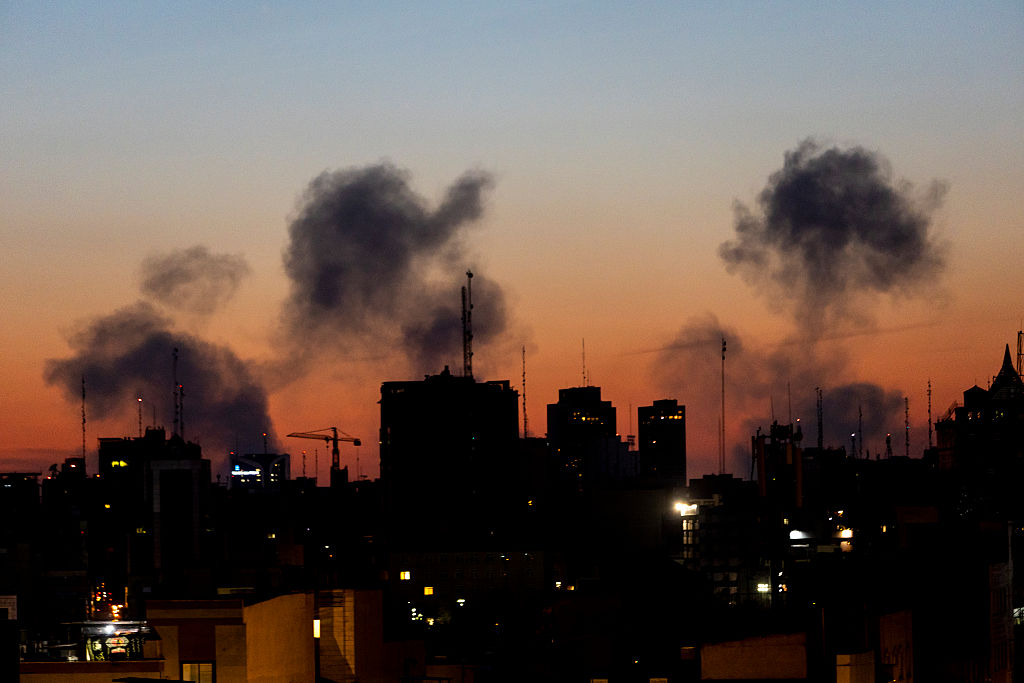
Between all the action around next week’s midterms and Donald Trump’s meddling in Brazilian politics, it’s easy to forget there’s a war going on. But sure enough, Trump’s war on Iran is still humming in the background, and every indication is that it could flare up in a terrible new way very soon.According to multiple reports, Trump has been planning a renewed attack on Iran that is likely to be launched after the midterms, though according to the Wall Street Journal, the president had not yet firmly decided whether he’ll go through with it. The renewed attack, the Journal reports, would be a “short, intense war” that would hit Iranian infrastructure, its munition arsenal, and its nuclear sites, or at least that’s what sources have told the US press. Sen. Chris Murphy, who has been briefed on some of the attack plans, has called them “insane” and said they would lead to “the likely destruction of our commitment to the rule of law,” which suggests something potentially broader and even more extreme.Funnily enough, a month before any of this reporting was published, Quincy Institute Executive Vice President Trita Parsi had predicted to me that Trump was likely to do this, as a way of trying to end the war on his terms. “Trump has come to a space in his mind in which he believes that he has already tried everything. He’s tried diplomacy. He’s tried sanctions. He’s tried limited war,” Parsi said in mid-September.“The only thing he hasn’t tried is all of those different military threats he issued early on, but never exercised: taking out the desalination plants, taking out Iran’s energy infrastructure, taking one of the islands in the Persian Gulf. I think after the midterms, that is what he’s going to try.”Trump has, not surprisingly, been egged on in this by Israeli Prime Minister Benjamin Netanyahu, who in the lead-up to the Israeli election this week repeatedly vowed to restart the war against Iran and “overthrow” the remnants of the regime there. But according to the Israeli press, Netanyahu went beyond merely pushing for war: he actively looked to start one with a planned attack on Iran that he was ultimately talked out of. As Netanyahu openly said this week on Twitter/X, he and Israel had a narrow “window of time” to act — specifically, “another two years of Trump to finish the work in Iran.”Netanyahu’s obvious attempts to spark renewed war with Iran briefly became an election issue in Israel, when one of his opponents announced he had requested a treason investigation into the prime minister over his “pressuring the heads of the security establishment to take steps that could create a miscalculation vis-à-vis Iran,” and trying to “drag the state of Israel into war on the eve of elections.” Netanyahu has a history, especially over the past three years, of using war as a means of keeping himself in power, and it’s not hard to see how a war with Iran — particularly one he could sell as being started by Tehran — could give him a popularity boost.Netanyahu’s efforts to do this may not have worked out for the moment, but the currently deadlocked Israeli election result, combined with Trump’s preexisting plans to restart the war as soon as a week from now, could give him another shot at it. If Netanyahu’s opposition remains unable to form a government, he will stay on as caretaker prime minister until the next election, by which point a US war with Iran may well have provided a shot in the arm to his far-right coalition.Playing With FireBut however “insane” and brutal this latest US bombing campaign turns out to be, it’s unlikely to give Trump what he wants: for Tehran to soften its demands and take a deal that’s worse for them and better for him.Trump’s actions — including his repeated violation of agreements and diplomatic protocols, and the sneak attack that killed scores of Iranian officials at the start of the war — have thoroughly delegitimized Iran’s moderates and placed the country firmly in the hands of hard-liners who oppose negotiations, and some of whom do things like move to impeach the country’s more pro-diplomacy foreign minister.These hard-liners believe that any deal Iran strikes with Washington is pointless, because Trump or his successor will just rip it up later regardless. The hard-liners are convinced the only way to ensure both the state’s and the country’s survival is to inflict such costs on the United States and its political leadership that they’ll leave their country alone. They are also, ironically, now looking seriously at actually pursuing a nuclear weapon — a pursuit Iran’s previous supreme leader had, it turns out, been the main roadblock to, until Trump dropped a bomb on his house in February and killed him.Trump still reportedly hopes that using military force will this time stop Iran from making a bomb. But that idea is likely to run into the same problem as before: namely, that Iran’s buried nuclear sites are basically unreachable, even by the largest bombs the United States can drop on them, so he would need to launch a risky ground operation to extract the enriched material that still wouldn’t be guaranteed of success. Look at how costly the vastly less complicated effort to recover a single pilot in April proved, and you start to get a sense of the difficulty with this idea.Meanwhile, Iran’s new hard-line leadership is willing to absorb (or more accurately, willing to let the Iranian people take) a tremendous amount of pain to achieve this, as they have demonstrated. Years of preexisting suffering under US sanctions and a rally-’round-the-flag effect that has seen anti-government dissent evaporate means life in Iran is persisting in the face of widespread shortages, nearly 90 percent inflation, and at least $270 billion worth of destroyed infrastructure.So what would a “short, intense war” on Iran actually do, then? Besides the human toll on ordinary Iranians just trying to live their lives, it would likely mean even worse blowback on everyone else, the United States included.Like Trump, Iran’s leaders have military cards they haven’t played yet, and they are openly threatening much worse retaliation this time if they’re attacked again. Iranian officials have threatened to make the war “longer and in a wider geographical area,” and to inflict a “devastating impact” on energy markets, aiming to shove the world into outright recession and create a large-scale refugee crisis. Surrounding oil facilities, ports, pipelines, refineries, power grids, and even desalination plants have been mentioned as targets.This would be devastating for — and in the case of power grids and desalination plants, existentially threatening to — life in the Gulf states, whose economies have already been battered by the war. This is why a host of Iran’s neighbors, including Qatar, Saudi Arabia, and Turkey, have been desperately holding talks with Tehran to try to stop what might be the most devastating round of an already regionally destructive war, so far with no tangible results.But it’s not just Iran’s neighbors who will bear the brunt of this. Iran’s leaders specifically named as targets the undersea cables that carry internet traffic and the trillions of dollars of infrastructure in the region that the US artificial intelligence industry relies on, including data centers. That industry, which Trump is heavily relying on to prop up the US economy, is already showing serious signs of strain in the face of mounting financial losses and growing investor skepticism. Major damage to critical infrastructure and resulting market disruption risks adding further strain on an industry that many already fear is a bubble waiting to pop. In its recent initial public offering prospectus, AI firm Anthropic specifically mentioned the fact that “armed conflict” could damage or destroy data centers and other infrastructure as one of its risk factors, a warning that other industry players have made.More ominously, a senior Iranian security official has also named “US political targets” as potentially fair game. Recall, too, that Iran is widely believed to be the culprit behind months of cyberattacks on a variety of US infrastructure, including water systems. If either of these is part of Iran’s next retaliatory move, it would not only cause intense chaos and suffering for the US public but potentially trigger a dangerous escalation spiral.Vice President J. D. Vance has reportedly now reached out to Iran’s hard-line top security chief to resuscitate peace talks. Given everything laid out above, this would be wise.The Choice Is ClearThe trouble is that the two parties here remain a canyon apart. Iranian leadership views it as effectively suicide to budge from the terms they agreed to earlier this year, while Trump has been led to view those terms as a personal humiliation, so he keeps trying and failing to bomb or blockade his way to a more favorable deal after the fact. There is also the wild card of Netanyahu, who has already more than once tried to single-handedly torpedo a Trump-Iran deal by bombing Lebanon and violating one of Iran’s core demands.The White House now is certain that Iran is on the brink of capitulation, and all it will take is one more push to get it there. In reality, Trump is dealing with an Iran that is more dangerous and less likely to capitulate than ever: not because it has a nuke, but because years of Trump’s own foolish policy choices have turned it into an adversary that sees itself as having nothing to lose — and is acting like it, which is why Iranian leaders are effetively threatening that if they go down, they will take the entire region as well as the global economy with them.Trump and the people around him are looking at next week’s midterms as the moment they will be unshackled from political constraints, freeing them to take the reckless, escalatory measures they were reluctant to take before for fear of voter backlash. If they were smart, they would treat it as freeing them instead to take the deal they had already agreed to, and to just swallow the inevitable political point-scoring and cries of “capitulation” that are, sadly, now just standard whenever any president tries to end a war.But it is clear that there is a dearth of voices around the president that are inclined to tell him this. It is increasingly likely that Trump soon takes a step that will prove even more terrible for the country, for his political party, and his own legacy.This article originally appeared in Jacobin, a democratic socialist magazine publishing long-form essays and analysis on politics, economics, and culture. Subscribe to the print edition for $20 a year.
Visit afnews.co.za for more information.