Post-Flood Resilience Initiatives In Assam Under CSIR Smart Village Mission
· Free Press Journal
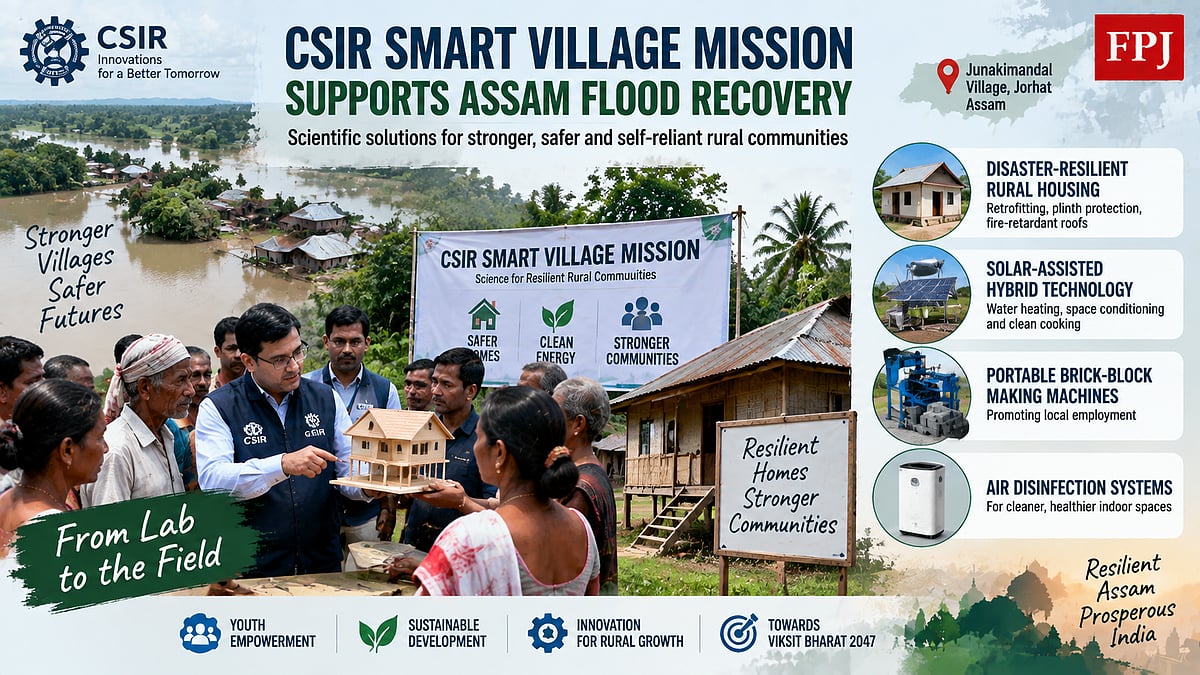
Jorhat, Assam, 22 September 2026: In the aftermath of severe floods that affected several villages across Assam, the CSIR Smart Village Mission has initiated coordinated field-level interventions in Junakimandal Village, Titabor, Jorhat, one of the villages selected under the Mission. The initiative aims to support post-disaster recovery through scientific and technological interventions while strengthening the long-term resilience of rural communities.
Recognising the damage to residential buildings, rural infrastructure and essential community facilities, Prof. Pradeep Kumar Ramancharla, Mission Director, CSIR Smart Village Mission, entrusted Dr. Kishor S. Kulkarni, Nodal Scientist, along with a multidisciplinary team from CSIR-CBRI, to undertake a field visit and assess the emerging needs of the community.
Visit lej.life for more information.
The team comprising Dr. Chandan Swaroop Meena, Principal Scientist; Dr. R. Siva Chidambaram, Principal Scientist; Ar. Nisha; Dr. Sumit; Ms. Arundhati; Mr. Anuj; and Mr. Pritom visited the flood-affected village. A field survey of affected houses was conducted to assess structural and non-structural damage and identify vulnerable building components. Based on the observations, suitable retrofitting and strengthening measures were suggested to improve the safety and flood resilience of existing houses.
‘Awas Saksham’ Workshop for Disaster-Resilient Rural Housing
Following the field survey, the team conducted a workshop on “Awas Saksham: Technology Demonstration for PMAY-G Beneficiaries” at Junakimandal Village. More than 150 members of the local community and government officials participated in the programme. Scientists interacted with participants and showcased CSIR-developed technologies with the objective of identifying appropriate solutions for deployment in the village.
The Awas Saksham programme aims to promote safer, affordable, durable and disaster-resilient rural housing under the Pradhan Mantri Awas Yojana–Gramin (PMAY-G). Considering the vulnerability of the region, special emphasis was placed on repair and retrofitting, plinth protection walls, non-eroded mud plaster, fire-retardant thatch roofs and bamboo houses.
Solar-Assisted Hybrid Technology for Rural Development.
During the programme, CSIR-CBRI showcased several technologies developed for rural applications, including Hybrid Solar Water Heating and Space Conditioning Technology.
To improve energy efficiency and convenience in village schools and Anganwadi buildings, Dr. Chandan Swaroop Meena, Principal Scientist, proposed the use of an energy-efficient solar-assisted hybrid system for water heating, space conditioning and kitchen-use spaces. The proposed system can provide hot water for sanitation and kitchen requirements, help maintain thermal comfort in classrooms during extreme weather conditions and support mid-day meal preparation through a clean energy source.
The technology can save up to 75 per cent of energy consumption compared with conventional systems while reducing dependence on grid electricity and conventional heating methods. The system has been indigenously developed and validated at CSIR-CBRI, Roorkee, and has also been deployed at Kalpa, Kinnaur, Himachal Pradesh, and with the ITBP at Leh-Ladakh. The technology is now ready for field-level deployment. The technology was developed by Dr. Chandan Swaroop Meena, Principal Scientist, CSIR-CBRI, Roorkee
Portable Brick-Block Making Technology to Promote Local Employment
CSIR-CBRI also showcased portable 100–125 kg brick-block making machines designed for village-level use with locally available materials. The machines can operate manually as well as electrically and can produce 800–1,000 blocks or 1,800–2,400 bricks in eight hours, which is significantly higher than manual production.
The technology is being demonstrated in villages across Madhya Pradesh, Odisha and Assam, with the objective of supporting local employment generation and strengthening rural construction capacity. The technology was developed by Dr. R.S. Bisht, Dr. Siddharth and Dr. S.K. Panigrahi.
UP Rise 2026: Youth Ideas Get A Platform At Invertis, 'Brahmabyte Innovations' Takes The Top SpotAir Disinfection and Capacity Building
Deployment of a standalone air disinfection system in the village has also been proposed to assist in disinfecting air in enclosed or poorly ventilated spaces and address indoor air-quality concerns that may arise following floods. The technology was proposed and developed by Dr. Tabish, Scientist.
To strengthen technical capacity at the local level, CSIR-CBRI also plans to organise training programmes for local masons and construction workers in and around the village. The training will familiarise local workers with safe and scientific construction techniques and provide practical exposure to modern construction practices.
These initiatives represent a significant step towards realising the CSIR Smart Village Mission’s core principle of taking innovation “from the lab to the field.” The interventions aim to support post-flood recovery, strengthen rural infrastructure and promote locally appropriate, affordable and resilient technologies, contributing to the vision of Viksit Bharat 2047.