There Is No Escaping The ‘Male Gaze’ Even In The Lok Sabha
· Free Press Journal
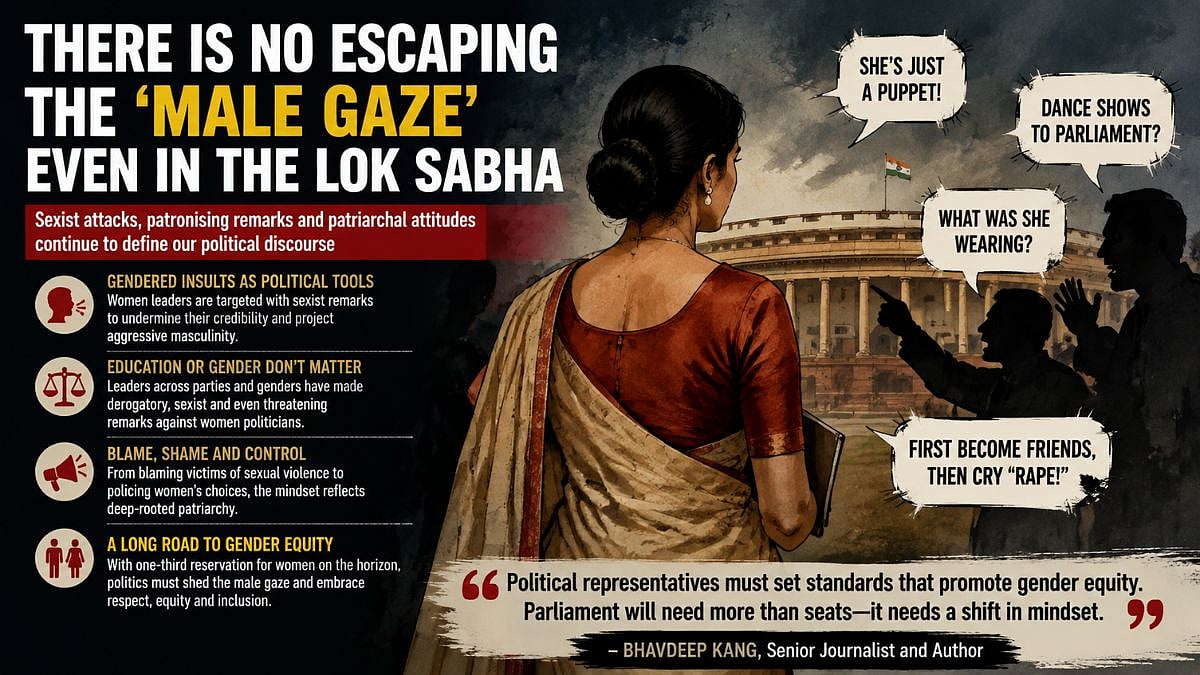
There is no escaping the ‘male gaze’ even in the Lok Sabha. Political masculinity often manifests in gender-insensitive remarks. Tamil Nadu Opposition leader Udhaynidhi Stalin’s snide allusion to the rumoured liaison between state Chief Minister C. Joseph Vijay and actor Trisha is one such instance. The objective was not just to create a sense of male fellowship through a shared joke (the crowd laughed) but to hint that the CM was under feminine control and, therefore, lacking in political competence.
In deriding women in the public space, more so if the target is a public figure in her own right, politicians attempt to project an image of aggressive leadership. They consciously sidestep political correctness in service of ideas of manhood centred around strength, power, dominance, control, and forceful behaviour. The offensive remarks we condemn as sexist are invariably politically loaded. Politicians like Mayawati, Smriti Irani, Jaya Prada, Hema Malini, Kangana Ranaut, and Priyanka Gandhi, to name a few, have all been targets of politicians from rival parties. By objectifying them in terms that reinforce gender stereotypes, the opponent seeks to undermine their credibility as political leaders.
Visit michezonews.co.za for more information.
Gendered Political Attacks
The notion that women who have progressed beyond their familial role as mother, daughter or sister to claim an identity of their own must be ‘put in their place’ provokes uncivil behaviour. Sanjay Nirupam, then a Congress MP, reportedly told Irani, “You used to charge money to perform dance shows on TV (thumke lagati thi). Now you are an election analyst.” It would appear that gendered insults are a rite of passage that every woman politician must undergo before she achieves the status of a ‘mother’ or ‘sister’ figure. J. Jayalalithaa, who was physically assaulted in the Assembly before she became Chief Minister, and Indira Gandhi, who was denigrated as ‘goongi gudiya’ (dumb doll), are classic examples. Former Congress president Sonia Gandhi additionally suffered racist remarks.
Education and gender do not modulate behaviour when party partisanship comes into play. Ranaut was the subject of a derogatory post from the handle of a woman Congress spokesperson, which referenced the dual meaning of ‘Mandi’ (her Lok Sabha constituency). Randeep Surjewala, a Congress leader and a lawyer, made a disrespectful comment about BJP MP Hema Malini during a public meeting. The Samajwadi Party’s Mohammad Azam Khan, also a lawyer, publicly stated that he had discovered his rival Jaya Prada wore “khaki underwear”.
We have witnessed politicians threatening rape of female family members as punishment for rivals, suggesting death for victims of rape (alongside the rapist), describing unmarried daughters as “liabilities”, using feminising terms for rivals to disparage them, undermining the reproductive rights of women, and advocating the marriage of minor girls and denial of mobile phones to young women to ‘protect’ them from sexual misconduct.
Victim-Blaming Culture
In a deeply patriarchal society, politicians reflect the resistance to the intrusion of women, not just in politics but in the public sphere as a whole. We often find them adopting ‘blame-the-victim’ postures vis-à-vis instances of sexual harassment. In the wake of the 2012 Delhi rape case, Congress MP Botsa Satyanarayana declared, “Just because India achieved freedom at midnight does not mean that women can venture out after dark.” Another Congress MP, Abhijit Mukherjee, directed his ire at the “dented-painted women protesters in Delhi (who) went to discotheques and then turned up at India Gate to express outrage”. Evidently, the victim had crossed an unseen ‘Lakshman rekha’ in being out on the streets at 9 pm and paid the price.
The prize for egregious insensitivity goes to Asha Mirje of the NCP: “Girls should be careful about what they wear. They should mind the time of their moving out. Girls' body language should not be such that it invites the attention of a potential rapist lurking around.” The late Mulayam Singh Yadav famously questioned the death penalty for rapists by saying, “First girls become friends with boys. Then when they have differences between them, girls level rape charges. Boys commit mistakes. Will they be hanged for rape?”
Progress And Persistent Bias
Today, politicians are a shade more wary of making misogynistic statements than they were even a decade ago, given the proven efficacy of the women’s vote. That brings us to the problem of ‘feminism lite’, a term popularised by feminist author Chimamanda Ngozi Adichie to describe patronising male behaviour, which sees feminine progress as mediated by men. One example is Prime Minister Narendra Modi congratulating his Bangladesh counterpart, Sheikh Hasina, for her tough stance on terrorism “despite” her gender. Legislations aimed at “protecting” women, such as those limiting surrogacy or demanding registration of live-in couples, can be seen in a similar light.
Political masculinity can be both progressive or regressive—a site of domination or of resistance. Under British rule, the projection of the male colonial subject as effete provoked 19th-century Indian leaders to assert muscular Hindu nationalism. On the other hand, Mahatma Gandhi’s masculinity was one of moral strength, expressed in non-violence and self-discipline in all spheres of life. But today, many politicians tend to take on a ‘strongman’ persona and project themselves in hyper-masculine terms. What’s disturbing is that this attitude spills over to political mobilisations, whether in the digital or public space. For example, during the Cockroach Janta Party protest in Delhi, we saw threats of violence and abusive statements being made for the benefit of TV cameras. Online, CJP supporters and detractors traded insults, with some instances of vicious trolling.
Challenge For Parliament
Political representatives are expected to set standards in society, including those that promote gender equity. Given the attitude of male politicians, who do not hesitate to dwell on the physical attributes or background of female public figures, one cannot but wonder how Parliament will adjust to having one-third of the seats reserved for women. It seems there is no escaping the ‘male gaze’.
Bhavdeep Kang is a senior journalist with 35 years of experience working with major newspapers and magazines. She is now an independent writer and author.