Neil Gorsuch Urges Supreme Court To Correct 2 Wrong Turns That Undermined Civil Liberties
· Reason
Two weeks ago, the Supreme Court ruled that "an agreement not to appeal a sentence is unenforceable when it would result in a miscarriage of justice." This week, the Court held that a government-ordered analysis of cellphone location data qualifies as a "search" under the Fourth Amendment.
Visit extonnews.click for more information.
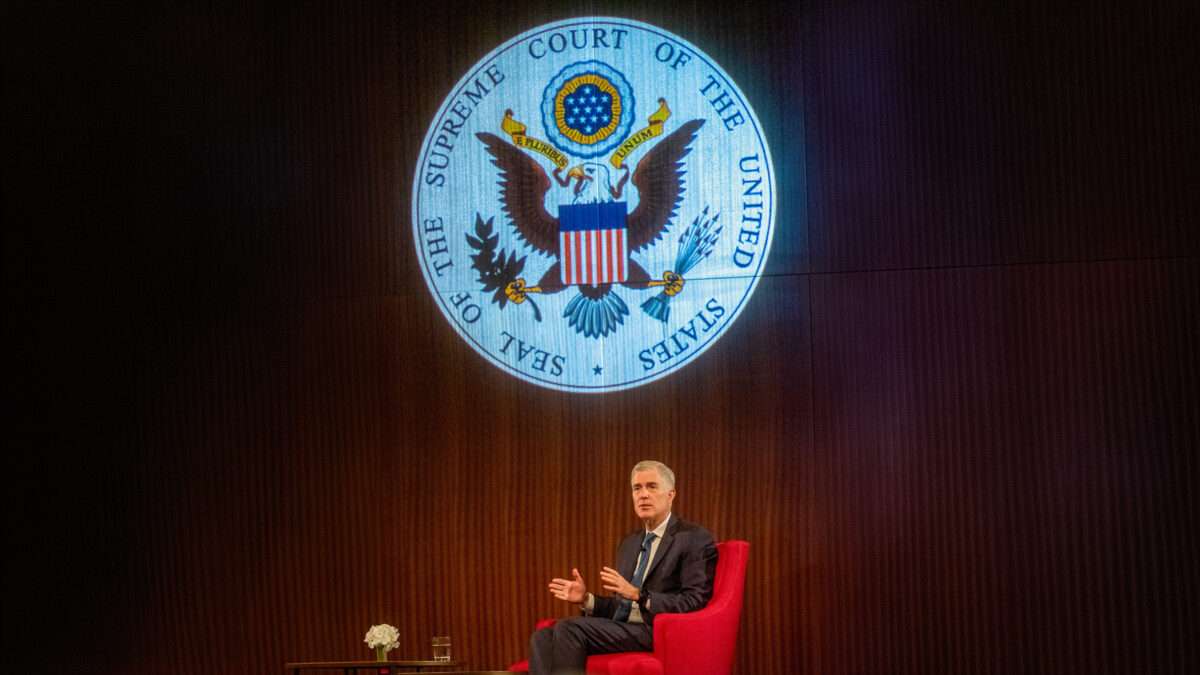
In both cases, Justice Neil Gorsuch agreed with the result but wrote separately to highlight deeper issues that the majority did not address: the Supreme Court's endorsement of coercive plea bargaining and its embrace of two dubious Fourth Amendment doctrines. Gorsuch's opinions, which criticize precedents that have undermined civil liberties, illustrate his talent for identifying wrong turns that his colleagues are not yet ready to acknowledge.
The first case involved Munson P. Hunter III, who was sentenced to four years in federal prison after pleading guilty to one count of aiding and abetting wire fraud. His sentence also included a requirement that he undergo psychiatric treatment after his release and "take all mental health medications" prescribed for him.
Hunter objected to the latter condition, saying it violated his "constitutionally protected liberty interest in avoiding the unwanted administration of antipsychotic drugs." But the U.S. Court of Appeals for the 5th Circuit said he was not allowed to raise that issue because he had given up his right to contest any aspect of his sentence, as federal defendants usually do when they plead guilty.
The Supreme Court disagreed, saying Hunter should be allowed to argue that forced medication qualifies as a "miscarriage of justice" because it is unconstitutional. Gorsuch concurred, noting that an appeal waiver can hardly be considered "knowing and voluntary" when the defendant does not yet know the details of his sentence.
Gorsuch went further, emphasizing that the appeal-waiver issue is just one facet of a broader problem. "In our times, the jury trial has given way to a conveyor belt of plea bargains," he wrote, noting that about 95 percent of felony convictions in the U.S. are based on guilty pleas, typically obtained under the threat of additional punishment for defendants who insist on exercising their Sixth Amendment rights.
That situation would have dismayed the Founders, who viewed trial by jury as an essential safeguard against tyranny. Yet "when confronted with coercive prosecutorial tactics designed to induce defendants to take plea deals," Gorsuch noted, "the Court has often condoned those practices or let them pass in silence."
The second case involved a Virginia bank robbery investigation in which police used a "geofence" warrant to identify the perpetrator by requiring Google to search customer data collected by its Location History feature, which tracks the whereabouts of cellphone users. Such records, Gorsuch argued, qualify as "effects" protected by the Fourth Amendment.
Instead of taking that property rights approach, the majority asked whether cellphone users have a "reasonable expectation of privacy" in their location histories. That Fourth Amendment test, which the Court invented in 1967, "has no basis in the Constitution's text or history," Gorsuch complained, and it has never been clear how courts should determine when an "expectation of privacy" is "reasonable."
The Court compounded the uncertainty in 1976, when it announced that Americans do not have a reasonable expectation of privacy when they voluntarily share information with third parties. Although that doctrine would seem to exclude records stored by tech companies like Google from the Fourth Amendment's protection, the majority in the geofence case rebelled at that implication.
Given the huge amount of sensitive information that Americans routinely store on third-party servers, that reaction is understandable. But like a similar 2018 decision dealing with location data collected by cell sites, this one seems inconsistent with the Court's precedents.
Gorsuch thinks the Court should ditch those precedents, which he says are indefensible in theory and unworkable in practice. He also thinks the Court should reconsider its blasé attitude toward coercive plea bargaining.
When the justices make mistakes, correcting them is a slow, uncertain process. But it begins with opinions like these.
© Copyright 2026 by Creators Syndicate Inc.
The post Neil Gorsuch Urges Supreme Court To Correct 2 Wrong Turns That Undermined Civil Liberties appeared first on Reason.com.