Climate Concerns Take Centre Stage As Europe Experiences Severe Heatwave
· Free Press Journal
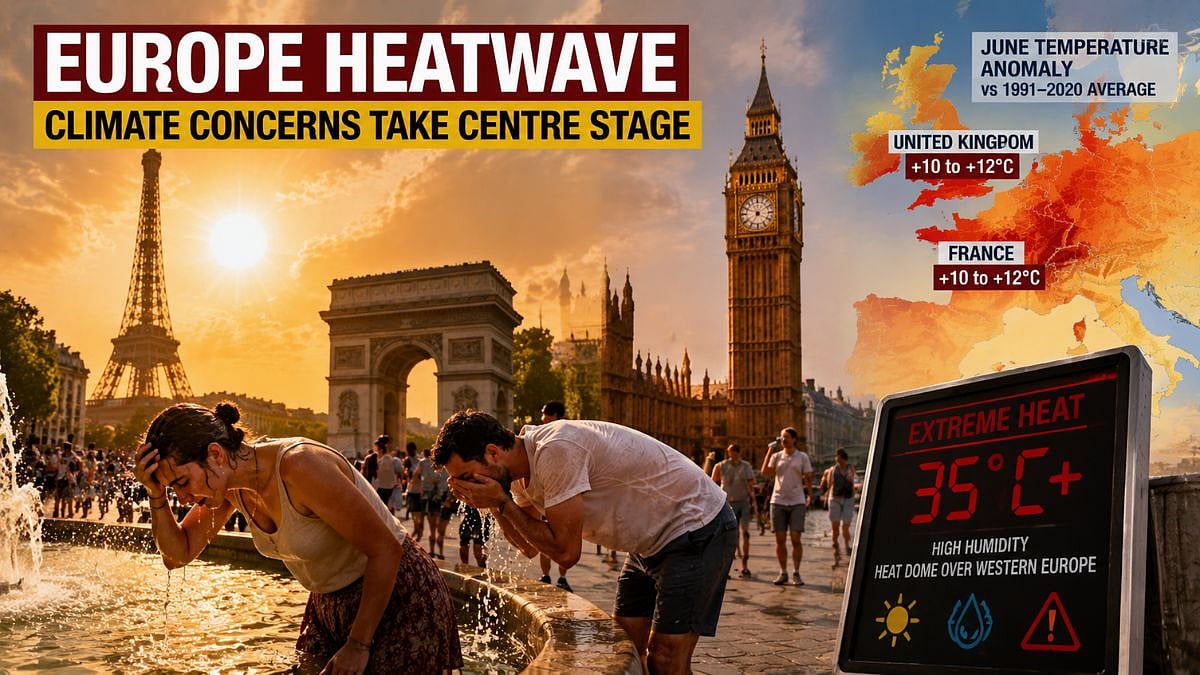
The heatwave that has swept Europe and led to about 1,300 excess deaths so far is another reminder that climate denialism by conservative politics imposes the heaviest burden on the average citizen. A look at the peak temperatures recorded in Western Europe in June shows frighteningly high temperatures in France and the United Kingdom, with seasonal variations of 10 to 12 degrees C above normal compared to the 1991-2020 baseline.
This is not the first time this part of the world has been cooked by the sun, and there were severe seasons in 2003 and 1976, but temperatures were lower then than at present.
Visit mwafrika.life for more information.
The scientific view of the European solar-cooker effect must be centred on higher global temperatures caused by human activity and not just the El Niño that has set in. Global warming by any country affects everyone.
Even among scientists, there are differences over how much impact human activity and the resulting carbon emissions have on climate variations. Credentialled researchers, such as Columbia University's James Hansen, view the conclusions of the UN Intergovernmental Panel on Climate Change (IPCC) on the Earth's sensitivity to solar radiation as an underestimate.
There are forecasts that the El Niño effect and warming patterns combined could make 2026 the hottest year on record, with 2027 likely to surpass even that.
While scientists are looking to validate their estimates of man-made global warming impacts by December, several countries are contending with climate-hostile politicians, beginning with US President Donald Trump, and avaricious commercial interests working to slow down the green transition.
Europe Faces Escalating Climate Risk
This year's hot season has turned Europe into a veritable oven because a large high-pressure heat dome over the continent's west is drawing in hot air from North Africa.
Depressingly for residents, the probability of such extreme weather recurring has increased since 2003, making it 100 times more likely; conversely, the peak temperatures two and a half decades ago were 2 degrees C lower.
Europeans evolved to live with the cold but are now encountering torrid summers. They built homes without air conditioning, as in Germany, but must now cope with temperatures exceeding 35 degrees C. It does not help that high humidity and a layer of sweat worsen the effects of the heat, as the body struggles to keep its temperature near normal.
It is worth recalling that the excess death toll in France, mainly among senior citizens, in 2003 was a staggering 15,000, followed by about 5,700 lives lost last year; the latest tally is not yet available.
If climate change is more likely to inflict higher temperatures, Europe should prepare its physical environment to cope by combining solar power and blue-green infrastructure with air conditioning. It is also a moment to steer politics in all countries towards saner waters and away from coal and oil.