Alan Greenspan, former U.S. Federal Reserve chairman, dies at 100
· Toronto Sun
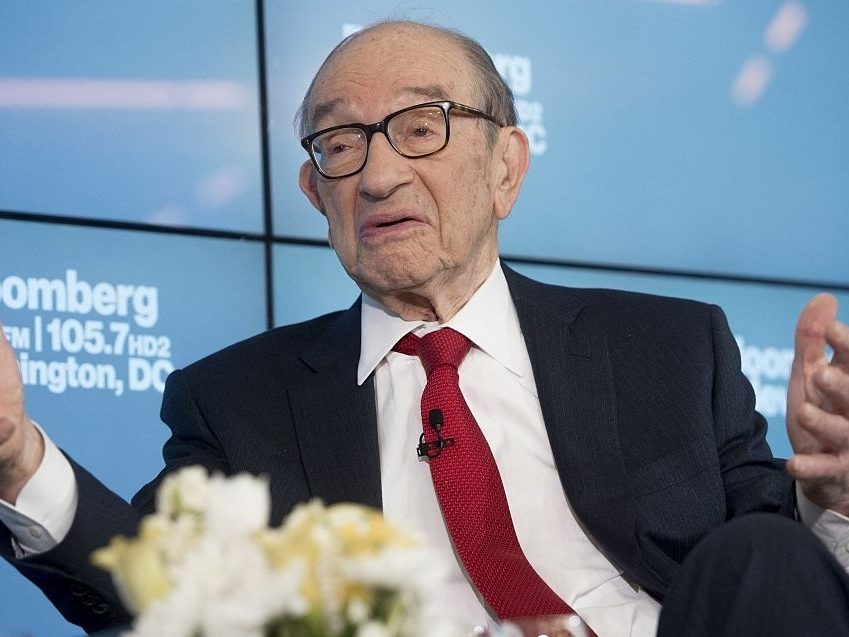
Alan Greenspan, who spent nearly two decades as chairman of the Federal Reserve, died on Monday “from complications of Parkinson’s.” He was 100.
The influential economist became one of the most powerful figures in global finance, serving as chairman from 1987 to 2006 under four American presidents — Ronald Reagan, George H.W. Bush, Bill Clinton and George W. Bush.
Visit freshyourfeel.org for more information.
His wife, veteran NBC News journalist Andrea Mitchell, 79, told NBC News that Greenspan died at their home.
“He was a giant of a man who helped shape the U.S. economy for decades under presidents of both parties, but was always honest in acknowledging his mistakes.”
She continued: “To me he was my husband, who shaped my life from our very first date in 1984. He had ‘irrational exuberance’ for baseball, the Washington Commanders, tennis, golf and music, especially jazz.”
Mitchell, who wed Greenspan in 1997, added: “He will be remembered for his brilliance and his kindness. Being his life partner was the joy of my life.”
Life ahead of the Fed
Greenspan was born in New York City in 1926 and balanced a passion for music with a head for business.
“I was the band intellectual who did their income taxes,” he told CNN in 2017.
Greenspan graduated from New York University’s Stern School of Business in 1945 with a bachelor’s in business, and five years later he received an M.A., and years later, in 1977, finished his Ph.D. in economics at NYU.
Before that, in 1955, he started the economic consulting firm Townsend-Greenspan & Co., Inc., which he ran for 30 years until he was nominated to run the Federal Reserve, according to the New York Times .
Greenspan also worked as corporate director for a host of companies, including General Foods and J.P. Morgan & Co.
In 1974, President Gerald Ford appointed him as chairman of the Council of Economic Advisers, a role in which he served until 1977.
Role in the Fed
Ten years later, Reagan nominated Greenspan as chairman of the Federal Reserve in June 1987. By August, he was confirmed by the U.S. Senate and a few months later, the Fed had to respond to the 1987 stock market crash.
Greenspan also steered the U.S. economy through the Asian financial crisis, the dot-com boom and bust, and the aftermath of the Sept. 11 terrorist attacks.
He earned the nickname “the Maestro” during the 1990s economic expansion and his 1996 warning about “irrational exuberance” (which his wife previously mentioned in her statement on his death) became a famous phrase in modern economic history.
Critics called out his policies
However, some economists weren’t fans, arguing that his policies helped set the stage for the 2008 financial crisis.
“I probably could have caught a number of different crises,” he told NPR in 2013. “I came very close in the dotcom boom.”
And in a 2008 Congressional hearing, he admitted he had “found a flaw” in his economic beliefs, according to the New York Times , and accepted more of the blame in a 2010 report, writing: “For years the Federal Reserve had been concerned about the ever-larger size of our financial institutions. Regrettably, we did little to address the problem.”
He continued: “We had been lulled into a sense of complacency by the only modestly negative economic aftermaths of the stock market crash of 1987 and the dot-com boom. Given history, we believed that any declines in home prices would be gradual.”
Greenspan’s tenure as Fed chairman ended in January 2006 after five terms.
In the years leading up to his retirement, Greenspan received an honorary knighthood from Queen Elizabeth in 2002 and a Presidential Medal of Freedom from Bush in 2005.
In his post-Fed years, he released three his memoir, The Age of Turbulence: Adventures in a New World, in 2007, and followed that with two more books — The Map and the Territory: Risk, Human Nature, and the Future of Forecasting in 2013 and 2018’s Capitalism in America: A History.