Are Global Skills Being Sidelined?
· Free Press Journal
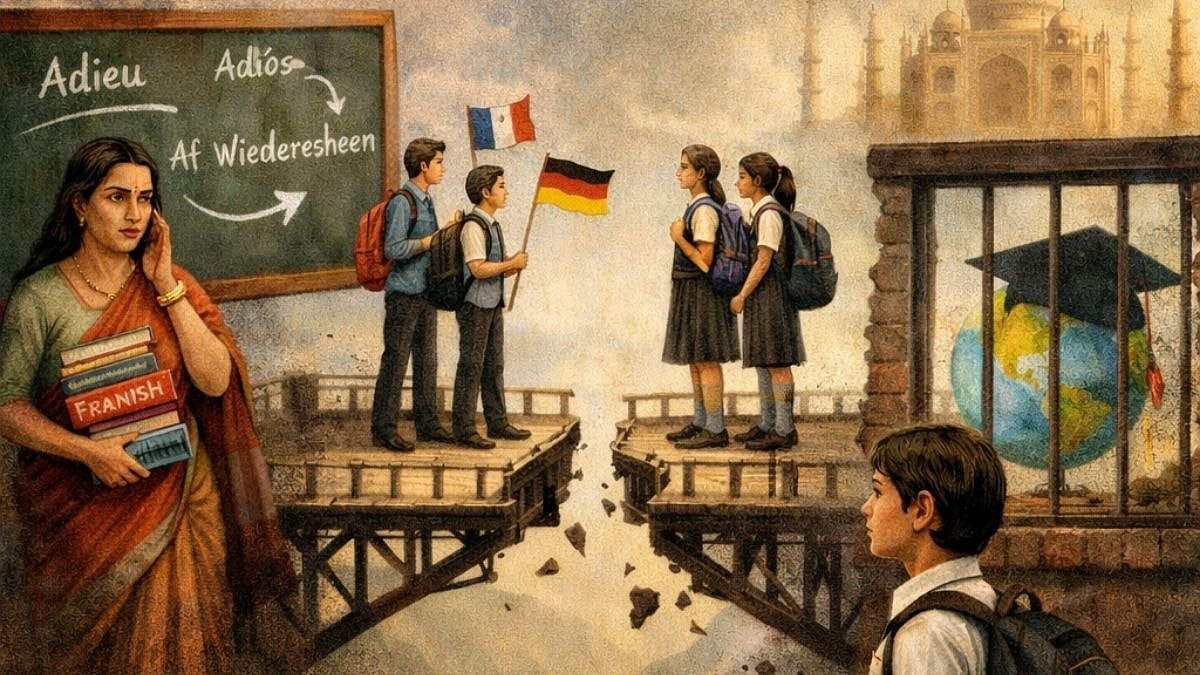
The recent change in the CBSE curriculum regarding foreign languages has sparked deep concern among educators. While the intent to promote Indian languages is widely acknowledged as valuable, its implementation has left foreign language teachers grappling with professional uncertainty and a growing sense of erasure.
Visit turconews.click for more information.
For many, the impact is deeply personal. Seema Haidry (name changed), a foreign language teacher from Delhi, captures this emotional upheaval poignantly: “My heart’s heavy. Since when did academics become something other than what’s important for a child—turning into a political subject?” Having devoted nearly 25 years to studying and teaching, she reflects on a career built around enabling students to become global citizens. “It is a matter of pride when we see Indians in high posts in foreign countries, and here we are clipping their wings,” she says. The lack of clarity about the future, she adds, is deeply unsettling: “After giving more than two decades of my professional life to this language, where do I stand today?”
This sense of displacement is echoed by Aman Bhat (name changed), a Spanish language teacher from Mumbai, who highlights the tangible impact foreign language education has had on students’ lives. “I have seen students go from classroom learners to professionals working abroad or for multinational companies,” he explains. For him, the curriculum change feels like dismantling a carefully constructed bridge between Indian talent and global opportunities. “Foreign languages are being viewed as optional luxuries rather than essential skills,” he says, warning that such a perception undermines the cognitive and professional advantages that multilingualism provides in an increasingly competitive world.
The ripple effects extend beyond classrooms. Latika Chaudhary, whose child studies in a Delhi government school, voices a concern shared by many parents: “I cannot afford to put my child in an IB board or a private school. My child goes to a government school in Delhi, and learning French was allowing my child to have the same opportunities as those in expensive schools.” She fears that the changing norms will not only curb her child’s growth but also deepen inequality. “Education is about reducing the divide and providing equal opportunities—then why introduce a change that creates an abyss between children?”
From a broader perspective, Aditya Nath Pathak, a German language educator from Patna, situates the issue within a systemic framework. He acknowledges that promoting Indian languages is a worthy goal but argues that it should not come at the cost of global competencies. “Reducing space for foreign languages may unintentionally undermine their importance in a globalised world,” he says. The immediate challenge, according to him, lies in the lack of clarity around implementation and the shrinking scope for foreign languages within formal schooling.
Under the revised framework, schools are required to adopt a three-language formula in which two languages must be native to India, with English classified as a foreign language. In practice, this means that students from classes VI to X will study two Indian languages alongside English, leaving little or no room for an additional foreign language such as German, French, Japanese, or Spanish. Previously, many schools offered greater flexibility, allowing students to opt for a foreign language as their third language.
Pathak raises a critical concern about this classification. “While strengthening Indian languages is important, global competencies, including foreign language skills, are equally essential,” he emphasises. Given that English is deeply embedded in India’s education system, governance, and professional sectors, labelling it strictly as a foreign language appears debatable. He advocates for a more flexible approach that allows students to choose languages aligned with their aspirations.
Beyond policy, educators stress the transformative power of language learning. Sireen Ahuja (name changed), a Japanese-language teacher, shares a deeply personal journey: “I started studying Japanese when I was 35. I had always struggled with studies, and very late in life I found something I was good at. That opened the world for me.” This sense of discovery, she argues, is precisely what education should facilitate. “When students go abroad as exchange students or for higher education, their ability to converse helps them cope with the shift. Education is about widening horizons.” However, the current changes, she feels, risk doing the opposite. Instead of restricting foreign languages, she suggests revitalising Indian language curricula. “Why try to eradicate a language in the name of saving culture, rather than enhance your own?”
The long-term implications are equally concerning for veteran educators like Anuradha Karkun, who has devoted 40 years to teaching French. “It is not a simple thing to become a teacher of a foreign language; there are many levels you have to pass before you are allowed to do so,” she says. She emphasises that such dedication cannot be disregarded overnight. “The core of any language is bringing people together, going beyond boundaries—by eradicating one, we are distancing ourselves from other citizens of the world.”
The economic implications of the shift are also significant. “For continuing the language, students will have to rely on private tutors or institutes, which every parent may not afford,” she points out, warning that this could lead to increased inequality. “Languages help break barriers in the age of globalisation,” she adds, emphasising the cultural richness and adaptability that language learning fosters.
Across these perspectives, a common thread emerges: the fear that limiting foreign language education will narrow students’ worldview at a time when global interconnectedness is more crucial than ever. Educators are not opposing the promotion of Indian languages; rather, they are advocating for a balanced approach that does not force a choice between national identity and global engagement.
The current policy, in its rigidity, risks undermining this balance. By restricting curricular space, it inadvertently signals that foreign languages are dispensable, despite their proven value in fostering cognitive flexibility, cultural awareness, and professional mobility. As one educator succinctly puts it, “We are making our growth stagnant.”
CBSE Class 10 Result 2026 Likely To Be Declared On This Date In April At cbse.gov.in; Students Can Check Online, SMS & DigiLockerUltimately, the debate is not merely about language but about the kind of education system India envisions for its future generations. An inclusive, forward-looking framework would recognise that linguistic diversity—both Indian and global—is not a zero-sum game but a collective asset. Without such recalibration, the cost may not only be measured in lost opportunities, but in the narrowing of horizons for generations to come.